
Proximity Fuels Growth
February 16, 2026
Mondelez Latam TicTacToe Innovation Mindset
February 16, 2026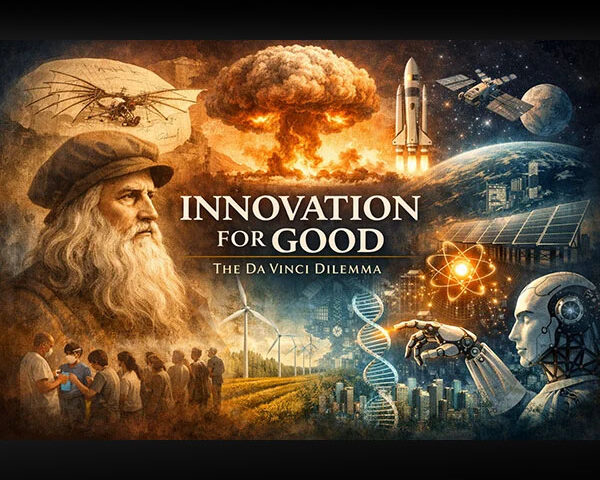
Human curiosity creates tools, and human incentives decide their purpose. History has shown that innovation requires a purpose-based governance system to serve humanity.
We like to tell the story of innovation as a steady climb toward progress. History is less tidy. The same breakthroughs that extend life, reduce hunger, or connect communities can also magnify harm, and in a faster scale no one originally imagined. “Innovation for good” is not a category of inventions. It is a choice, made repeatedly, by inventors, funders, regulators, and societies.
To understand the tension, it helps to begin with an early inventor who treated it as a real dilemma: Leonardo da Vinci.
Nature is consistent, and that consistency becomes capability
Leonardo’s fascination with flight was not wishful thinking. It was a disciplined observation. By studying birds, air currents, and anatomy, he assumed that nature follows rules. Those rules once understood are translated into human design. This is the quiet foundation beneath modern science and engineering: nature and humans are not separate realms. They are consistent with one another.
The Da Vinci triad: ingenuity, dignity, and discipline
I believe that one of the most striking lines Da Vinci notes is when he describes (or should I say, decides to avoid describing) underwater breathing. Considering how thorough he was to document his observations; it is mind blowing the fact that he refuses to publish his findings because he predicts misuse:
“How and why, I do not describe my method of remaining under water…
and this I do not publish or divulge on account of the evil nature of men
who would practice assassinations at the bottom of the seas….”
From this, we can extract a framework that holds across centuries of innovation: Leonardo recognized that invention does not end at creation. It also requires the right ethics to define direction, and the right discipline to ensure innovation serves humanity.
But let’s be clear, Leonardo da Vinci was not a pacifist in the modern sense. He worked for military patrons, including the Duke of Milan, and openly designed weapons, fortifications, and siege technologies. His ethical significance lies in selectively constraining the spread of certain capabilities, not in rejecting innovation itself.
This selective dissemination restraint was present even while embedded in military innovation, choosing not to publish certain methods, such as underwater breathing techniques. His dilemma was not whether to invent, but whether specific knowledge should be widely shared once its capacity for asymmetric harm became clear.
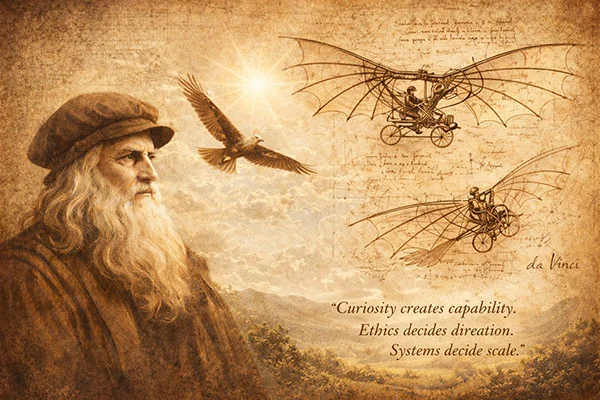
Da Vinci dream of flying realized and then militarized. Just as gunpowder.
Leonardo’s dream of flight eventually became real. Then it became strategic. Once aviation proved decisive, rapid iteration followed the logic of survival: in war times, air superiority is a prerequisite to victory.
Incentives have shaped innovation throughout history. Gunpowder, initially invented in China for signaling and celebration, once available in Europe it evolved into firearms and artillery as geopolitical and imperial powers rose. The system rewarded domination, and innovation followed.
And yet, across the same centuries, other innovations widened human possibility: printing and literacy, navigation and trade, improvements in agriculture, sanitation, and education. History is never purely light or dark. It is a contest of incentives.
Part 2: How to operate with Innovation Discipline to ensure the right moral direction across industries
The CPG Industry: the quiet battleground of everyday dignity
If warfare is the loudest arena for dual-use innovation, consumer goods are the quietest, and that is exactly why they matter. CPG innovation sits inside automatic habits: eating, cleaning, hygiene, childcare. When done well, it scales every day human needs: health, cleanliness, time savings, and safety without requiring anyone to be an expert.
Toilet paper is a perfect example. While it may not be glamorous, it represents a significant advancement in civilization-level hygiene. The debate often simplifies to the notion that “paper equals waste,” but public opinion often overlooks the fact that responsibly managed forestry can operate in regenerative cycles, much like any sustainable harvested agricultural system. In the case of trees used for toilet paper, such as pine or eucalyptus, this reforestation cycle spans 7 years. The ethical distinction lies in the supply chain: the methods of harvesting, replanting, ecosystem protection, and transparency of the system to consumers. Still, would it be very cool if innovation can find another way to make toilet paper?
CPG also shows how modern harm can be chronic and invisible. Ultra-processed foods can improve convenience and affordability while accumulating population-level health risks over decades. “Forever chemicals” like PFAS delivered performance benefits in packaging and products before their persistence and exposure pathways forced new controls. These are not failures of invention. They are failures of discipline.
Tech: scale without the human voice
If innovation is meant to improve life for the greatest number of people on Earth, technology (and health) industries should be natural allies. Together, they shape survival, longevity, mobility, knowledge, and access. Yet this is where a modern tension becomes visible.
Here is an objective pressure test of a common theory: CPG and health tend to integrate ethnography and behavioral observation as core inputs, while many tech organizations treat the human voice as downstream. UX research exists, but it often sits below engineering decisions. The result is not indifference, it is distance. There is not an human oriented insights function that is the source of innovation ideas, and when exists, it is just a downstream checkpoint.
As AI moves deeper into biology and medicine, the upside becomes clearer, and so does the need for human-centered discipline. The most meaningful proof that Artificial General Intelligence can advance humanity was never about beating a human at chess or Go. It was when general-purpose models began solving scientific problems that resisted human intuition for decades.
Protein folding is the clearest example. AlphaFold enabled highly accurate protein structure prediction at scale, turning a long-standing bottleneck into a platform for accelerating biology. This is epistemic leverage: discovering patterns that speed up science itself. The potential upside is enormous: faster drug discovery, deeper disease understanding, and new therapeutics that could improve life for millions.
But capability changes governance requirements. As systems become more capable, errors become harder to detect, authority shifts toward model output, and statistical confidence can override lived experience. A system can be correct but still misaligned with human dignity. This is why the next era must treat the human voice as a design input, not a post-hoc correction.
Purpose as a disciplined operating system
Purpose is many times just an empty brand narrative. History on innovation suggests it must be an infrastructure. Real purpose shows up as discipline: rules that shape behavior when pressure rises.
- Problem definition: whose lives improve if we succeed? How will we improve their lives?
- Human voice integration: observation, ethnography, longitudinal feedback, neurological and behavioral responses. The surveys, engagement metrics and traditional interviews are outdated research methods.
- Pre-scale discipline: stress-testing for misuse, misunderstanding, and second-order effects before mass deployment.
- Post-deployment accountability: transparency, monitoring, governance, correction, and real consequences when harm appears.
This is how advanced fields learned to govern power: aviation safety, pharmaceutical regulation, and nuclear oversight. The difference today is timing.
Full circle with Da Vinci’s learning approach: ingenuity, dignity, and discipline
Leonardo did not fear knowledge. He feared what happens when ingenuity can be used in an irresponsible way. That is the throughline from gunpowder to aviation to uranium, and now to AI, and DNA science.
Curiosity will always create capability. Ethics, anchored in dignity, must decide direction. And only disciplined systems can decide whether innovation improves life at scale or erodes it quietly. The next generation feels the gap between purpose promised and purpose practiced.
History leaves us with a simple, unforgiving question: will we build the discipline to match our intelligence, or will we once again let scale and the wrong incentives to decide for us?
Selected source anchors for further reading:
Leonardo da Vinci, The Notebooks (underwater passage), public-domain translation via Wikisource.
Jumper, J. et al. “Highly accurate protein structure prediction with AlphaFold.” Nature 596, 583–589 (2021).
The Thinking Game Documentary. 2024. Director: Greg Kohls. Nobel Prize: Demis Hassabis.
NIST AI Risk Management Framework (AI RMF 1.0), NIST AI 100-1 (2023).
European Commission, “Guidelines for providers of general-purpose AI models” (timeline: obligations from 2 Aug 2025).